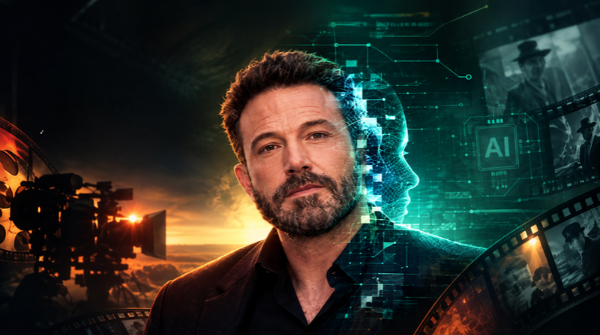
Since the emergence of artificial intelligence, concerns have grown across various fields that human presence could gradually disappear as machines take over an increasing number of professions, particularly creative ones such as cinema. This brings us to Hollywood, the world’s iconic “dream factory.”
AI is no longer merely a technology that sparks curiosity in Hollywood. It has become an active part of filmmaking, from scriptwriting and scene design to visual effects and sound. While studios see it as an opportunity to reduce production time and costs, concerns are growing that a tool created to serve creativity could eventually become a genuine competitor to the very people who create it.
Amid this transformation, American actor and filmmaker Ben Affleck raises the most difficult question: How far can cinema rely on machines without losing its human soul? The question goes beyond the position of a single artist, opening a broader debate about the future of creativity, creators’ rights, and who will ultimately have the final say in Hollywood: the human or the algorithm?
Artificial Intelligence… From Experiment to Reality
The figures reveal that AI’s presence in the film industry is no longer limited.
According to a study conducted by France’s National Centre for Cinema, involving hundreds of professionals working in writing, directing, production and cinematography, 65.3% of respondents had used AI tools, while 55.7% had used generative AI a type of artificial intelligence capable of creating new content, rather than simply analyzing or classifying existing material.
Among those using these technologies, 44.5% said they relied on them daily or regularly.
Hollywood Moves Forward… But With Caution
Despite this growing adoption, studios do not yet appear ready to hand over the entire creative process to algorithms.
Deloitte forecasts that major film and television studios in the United States and Europe were expected in 2025 to allocate less than 3% of production budgets to generative AI, while AI-powered tools could account for around 7% of operational spending, particularly in areas such as contract and talent management, planning, marketing, dubbing and translation.
When Speed Becomes Part of the Equation
For studios, the issue is not simply about producing more impressive visuals, but also about saving time and money.
Netflix says AI technologies have been used across around 300 productions, primarily during post-production or in the execution of complex shots. As an example of the technology’s economic potential, the company’s co-CEO Ted Sarandos pointed to a documentary that required around 17 minutes of AI-enhanced footage, saying the work was completed in roughly half the time and at about half the cost.
Ben Affleck… Inside the Revolution, Not Outside It
What makes Ben Affleck’s position particularly interesting is that he does not belong entirely to the “AI versus cinema” camp, nor does he subscribe to the idea that “machines can do everything.”
Affleck has used AI technologies in his upcoming film Animals, emphasizing that the film is fundamentally “very human” and that technology can serve as a tool to help filmmakers, but should not replace artistic vision.
Affleck had also founded InterPositive, a company specializing in filmmaking technologies, before Netflix acquired it in a deal reportedly worth around $587 million. The company developed tools designed to accelerate production and post production processes while keeping creative decisions in the hands of filmmakers.
Affleck’s position, therefore, appears more nuanced than simply accepting or rejecting AI: the technology is here and will continue to expand, but its use, in his view, should remain in service of the film rather than turning the film itself into a machine generated product devoid of human vision.
The Real Battle… Who Owns Creativity?
The concerns extend beyond jobs to questions of identity, rights and intellectual property.
In October 2026, a Swedish advertising campaign brought the late artist Greta Garbo back to the screen using AI technology, after obtaining permission to use her voice and digitally generate her likeness. The experiment once again brought the issue of digitally “reviving” deceased public figures into the spotlight, along with questions surrounding the limits of using their image and voice after death.
The issue therefore extends beyond technology into a broader ethical and legal question: Who owns an artist’s face and voice? Who gets to decide how they can be reused?
And can artificial intelligence reproduce a performance without also reproducing the rights of the person behind it?
Human or Algorithm?
Perhaps the real issue is no longer whether artificial intelligence will transform Hollywood it already has. The more important question is how much space will remain for humans.
Cinema is not simply a collection of images, visual effects and sounds that can be generated quickly. It is vision, memory, experience, emotion and creative decision-making. AI may help bring an idea to life and potentially make production faster and less expensive, but it still faces a much harder test:
Can it create that idea from a genuinely human experience?
